
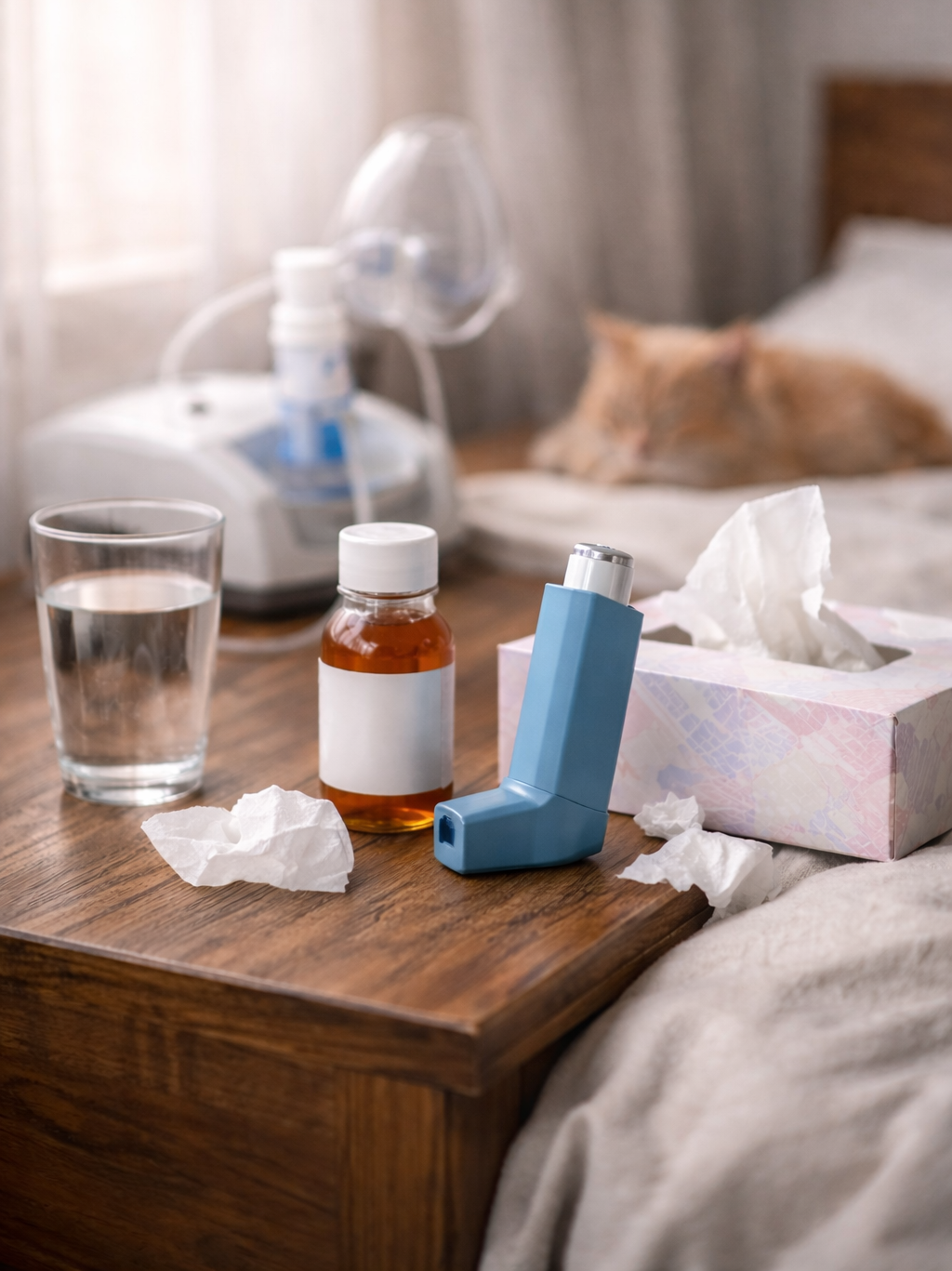
I don’t know if this happens to everyone, but ever since COVID-19, coughing just feels… different. Heavier. More stubborn. Like it refuses to leave once it shows up.
Almost everyone I know says the same thing—after COVID, a cough takes forever to completely go away. I’m one of those people, too. When I was younger, my coughs always took longer than usual to go away. I remember having to take samples of the mucus I coughed up to the hospital just to make sure nothing serious was going on. In the end, everything came back clear. There was nothing wrong—my body just needed more time.
But after COVID, it got worse.
Last year, shortly after Eid in April, I caught a fever. Like most fevers, it went away after a few days. But the cough? It didn’t.
It dragged on for months. Not weeks—months! I tried different cough medications, visited clinics, and even had to take nebulizer treatments (neb). Somehow, by around September, it slowly went away. That was about 5 months of coughing.
I thought that was the end of it.
It wasn’t.
After that long cough, something else started happening. Almost every night, my chest would begin to wheeze. I’d feel tightness in my chest, like I couldn’t get enough air in. Breathing became uncomfortable, especially at night. I would wake up in the middle of the night and have to cough up thick mucus—sometimes light yellow, sometimes completely clear, but always dense and almost solid. At first, I brushed it off. I told myself I was just tired. Or stressed. Or maybe my allergies were acting up, or my body was still recovering.
But it didn’t stop.
Deep down, I knew something wasn’t right.
I went to a private clinic. The doctor asked about my history with asthma, and she told me something I wasn’t expecting: my asthma might be back.
But if I’m being honest, I didn’t take it seriously. I’d been told similar things by doctors years ago—even in my 20s—when I went to clinics for breathing problems. Each time, I felt okay afterward. I could still be active and do physical activities without any major issues. So I brushed it off, telling myself maybe they were wrong.
I thought asthma was part of my past
As a child, I had severe asthma. My mum told me I needed treatments often, and it was something my parents worried about a lot. But as I grew older, the symptoms slowly disappeared. Eventually, asthma just… stopped being part of my life, so they assumed it was gone for good.
What I didn’t know—what no one really tells you—is that asthma doesn’t always disappear forever. Sometimes it just stays quiet—until something triggers it again.
In my case, I think it all started after that long, unresolved cough.
I used to avoid government health facilities (Klinik Kesihatan) for a long time because of the long waits. If you know, you know. But recently, I got scared enough to stop avoiding it.
Last weekend, I felt completely exhausted. Then came the fever, followed by a sore throat and a cough. And this time, it made my wheezing so much worse. That night, I felt like I couldn’t get enough air. My chest felt tight, and I was wheezing loudly. I remember walking to the kitchen to get some water, and my head suddenly started spinning. My vision blurred, and I had to sit down on the kitchen floor because I felt like I might faint. I didn’t sleep at all that night. I was struggling to breathe properly.
That was the moment I knew I couldn’t ignore this anymore. I needed to get this properly checked.
Having my checkup at Klinik Kesihatan
Since I live in Putrajaya, I went to Klinik Kesihatan in Presint 9. To my surprise, it wasn’t crowded at all. I booked my appointment through the MySejahtera app, which honestly made things so much easier. However, I won’t lie—I was slightly annoyed at how many times I had to scan my card. Yes, a lot of scanning 😅 Every time there was a procedure, such as a blood and COVID test, I had to scan again. I even felt on the verge of tears at one point because it stressed me out.
Still, despite all the scanning and waiting, everything moved fairly quickly.
When the doctor examined me, she confirmed I was COVID-negative. But after listening to my breathing, she immediately noticed how tight my chest was. At that point, my wheezing was loud and obvious. She advised me to take a neb.
I had to scan again. 😂
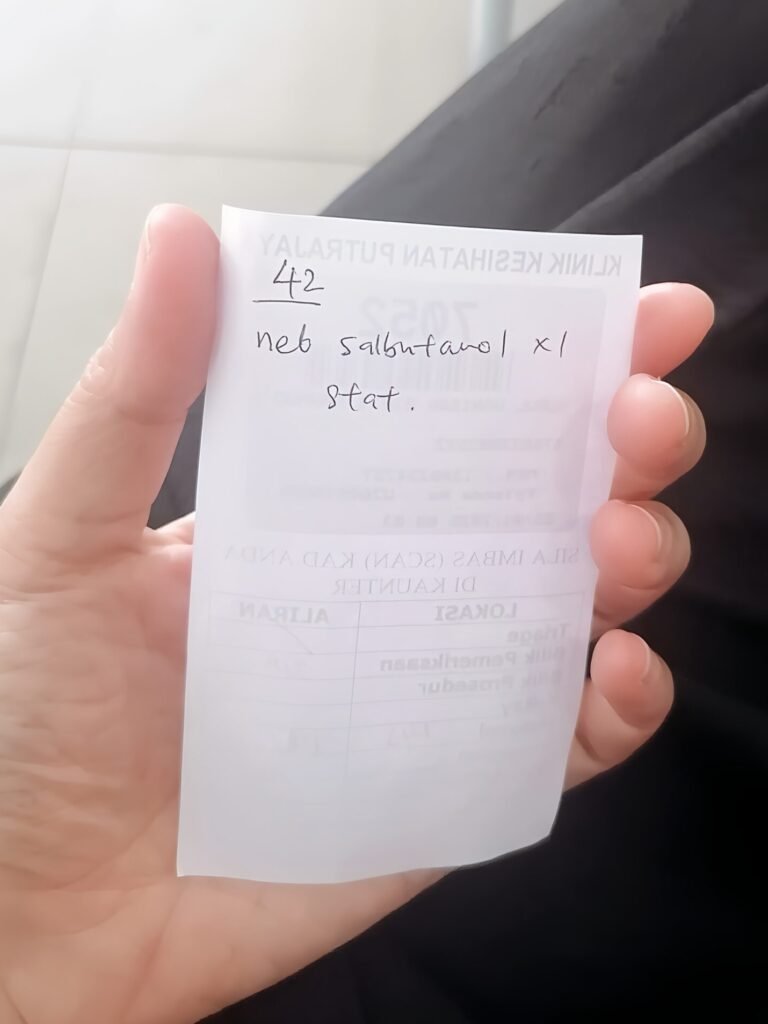
After the neb, I felt so much better. My breathing improved. My wheezing stopped.
And that’s when she explained something important.
If this were just an infection, my chest wouldn’t have responded to the neb much. But because it cleared up, it strongly suggested that asthma was involved.
That’s when she said it clearly: My asthma has most likely come back.
The doctor explained that my asthma symptoms often get worse at night and after showering because cold air or a drop in body temperature can cause the airways to tighten, triggering wheezing and shortness of breath. She asked me to start paying attention to what might trigger my asthma.
For now, I’ve noticed a few patterns:
- Cold air
- Physical exhaustion
- And possibly… my cat
I’ve had my cat for a while, so it’s hard to accept that he might be affecting my lungs gradually. I’ve always been an active person, or at least I used to be. I run, I hike, and take part in many physical activities. I can exercise without any breathing problems, which makes this all the more confusing.
Maybe age plays a role. Maybe post-COVID lungs are just more sensitive. Maybe it’s a combination of everything.
Honestly? I don’t fully know yet.
The doctor gave me some medication for my lungs, including the blue reliever inhaler to use only when needed. I also need to monitor my symptoms over the next 6 months. If I end up needing the neb often, I may need to start a daily inhaler to manage my asthma.
And that’s the part I’m not thrilled about. I don’t want to depend on medication.
But at the same time, I know that breathing is not something you negotiate with. Ignoring symptoms doesn’t make you strong; it just makes things worse.
What I’ve learned so far (and what might help you too)
One thing I’ve learned through all this is that our bodies change, and sometimes they ask us to slow down and pay attention. Here are a few things I wish I’d known earlier.
- A cough that lasts for months is not normal. Get it checked
- Childhood asthma can return later in life
- Post-COVID lungs may be more sensitive than we realise
- Wheezing, chest tightness, and breathlessness, especially at night, are signs you shouldn’t ignore
- Government clinics aren’t as scary or inconvenient as we imagine anymore
I’m still observing my body. I’m still learning my triggers. And I’m still hoping I won’t have to rely on daily medication.
But for now, I’m choosing awareness over denial. Care over avoidance.
So if you’re reading this and you’ve gone through something similar—if you’ve had asthma return after childhood or post-COVID breathing issues, please share your experience. I’d really love to hear from you.
⭐ Are there things that helped you manage your wheezing better?
⭐ Any lifestyle changes, habits, or small adjustments that made a difference?
⭐ Any “hacks” that worked for you?
⭐ Is there something I’m missing that could make a difference?
I’m open to trying anything that helps me live without constantly worrying about my lungs. If you have suggestions, please share—anything, even small things, might help. Whoever you are, thanks!
—Auri Duham 💘


